
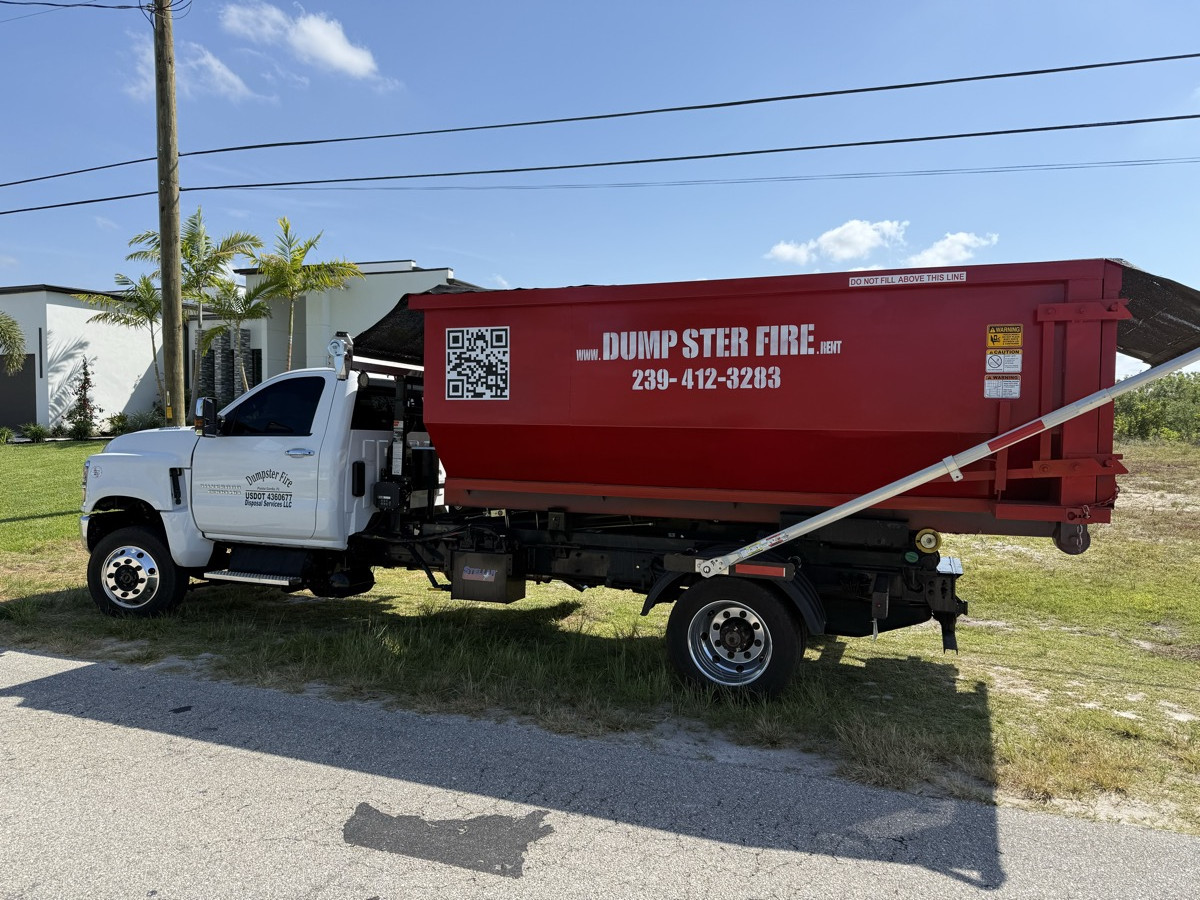
You did it. You finally cleaned out the garage, wrestled that ancient couch through the door, and waved goodbye as our white Dumpster Fire truck rumbled off. And there's probably a tiny part of you wondering where all that junk actually goes.
Do we sort through it by hand? Ship it to some mysterious facility? Catapult it into the Gulf of Mexico? (That last one's a no.)
So here's the actual path your junk takes after pickup, from your driveway through the recycling and disposal process and finally to either Charlotte or Lee County. It's less "dumpster fire" and more "organized chaos with a purpose."
What happens right after pickup?
It starts when you give us a call, or book online if you're fancy. You fill up your Dumpster Fire container with whatever life's been collecting in your attic, shed, or backyard: busted furniture, remodeling debris, those mysterious wires that probably go to something.
Once you're done, our crew arrives on schedule, hooks up the dumpster, and gets it safely loaded. We follow all Department of Transportation weight regulations (7,000 pounds per container max, because even we can't defy physics).
Then it's off to one of our local disposal or recycling facilities. We don't personally sort through each item. That's what the licensed disposal sites are for. Our job is to get your waste from Point A to the right Point B.
Along the way, we make sure:
- Loads are balanced and secured.
- Anything unsafe (propane tanks, paint, batteries) doesn't sneak in.
- The right materials go to the right kind of facility.
Once your dumpster's hauled off, it's officially out of your hair.
Where does it all end up?
We don't sort junk by hand in our yard, but the facilities we use absolutely do. Southwest Florida's waste system is built to handle just about everything you can toss into a dumpster, and each category of debris takes a slightly different route.
Let's follow a few of the usual suspects.
Metal and Scrap Recycling
Metal gets recycled over and over. Everything from old appliances to rusted-out swing sets can get melted down and reused. When we drop off loads containing metal, those materials are often pulled out and sent to regional metal recyclers. Eventually they'll get processed into raw steel again, maybe as rebar, maybe as new appliances, maybe as something unglamorous like storm drain covers.
Clean Wood and Yard Waste
Southwest Florida doesn't let good organic material go to waste. Clean wood, branches, and yard debris are shredded down for mulch or biofuel. That storm cleanup pile might eventually become landscaping material, or feed the biomass power programs that help the region reduce landfill strain.
Concrete and Construction Debris
Concrete and masonry can't go in your recycling bin, but they don't have to go to waste either. Facilities crush them down for use as road base, fill, or other construction materials. The busted-up patio you tossed might end up as part of someone's new driveway.
Electronics and Appliances
You'd be surprised how much value is hiding in that dead washing machine. Steel recyclers pull out the ferrous metal and send it off for processing, keeping tons of scrap out of landfills every year. Components that can't be reused are safely disposed of according to state guidelines.
General Trash
Not everything can be recycled or repurposed, and that's okay. Everyday household junk, drywall scraps, insulation, and similar waste are safely disposed of at licensed regional landfills like the Charlotte County Landfill or the Lee County Solid Waste Facility. Both are regulated, monitored, and engineered to handle municipal waste responsibly.
So while we're not back there hand-picking recyclables out of every load, your junk does get filtered by the professionals who specialize in that stage of the process.
What actually gets recycled?
Once your dumpster's contents are dropped off, the machinery takes over.
At transfer stations and recycling centers, giant mechanical claws, magnets, screens, and conveyor belts separate materials by type. Metals go one way, wood and yard debris another, and general waste down the line.
Metals are melted and re-cast into raw steel for manufacturing. Clean wood becomes mulch or biomass fuel. Cardboard and plastics, when present and clean enough, get baled and shipped for reuse.
This process keeps thousands of tons of material from ending up buried each year. It's not glamorous work, but it's what keeps Florida's waste system going. And it all starts with you choosing a hauler who takes the load to the right place, not just the easiest one.
Not everything gets a second life. Some junk just isn't recyclable. That soggy sofa, the crumbled drywall, the box of mystery wires. Off to the landfill it goes.
But even that's handled in a surprisingly careful way.
Charlotte County Landfill
In Charlotte County, waste gets buried in compacted "cells," layered beneath shredded wood, pallets, and mulch. Each layer helps stabilize the ground, control odors, and reduce methane buildup. It's not exactly a glamorous afterlife for your trash, but it's a lot more responsible than dumping it in a pit.
Lee County Solid Waste Facility
Lee County takes a different approach. Most waste there doesn't even get buried. It gets burned for power. The county's Waste-to-Energy plant incinerates solid waste at high temperatures, turning it into electricity that helps power local homes. The leftover ash is processed, compacted, and landfilled.
So yes, technically your junk might become power.
What does the disposal cost you?
It's already in the rental, which is the part people ask about. The 7-yard at $324.99, the 15-yard at $349.99, and the 20-yard at $424.99 each include delivery, pickup, and disposal, plus three days and a weight allowance of 2,000 to 4,000 pounds depending on size.
The only thing that changes the number is weight over that allowance, billed at $100 a ton at the exact weight rather than rounded up to the next ton. That's because the facilities charge us by the scale ticket, so heavier loads cost more to put through them. It's also why we ask what's going in before recommending a size: getting that right up front is the difference between the price you were quoted and a different one at pickup.
What can't we take at all?
Here's where we draw the line. Some things are too dangerous or too regulated for standard dumpsters. If it can leak, explode, or corrode through steel, it's not going in.
Common "do not toss" items include:
- Paints, solvents, and chemicals
- Propane tanks or fuel cylinders
- Car batteries or lithium batteries
- Motor oil and antifreeze
- Asbestos or lead-based materials
Florida law requires these items to be handled separately through hazardous-waste collection programs. Both Charlotte and Lee Counties offer drop-off facilities for residents, and a quick look at your county's solid-waste website will point you in the right direction.
If you're not sure about something, just ask when you book. We'll let you know what's safe, what's not, and where to take the rest.
At Dumpster Fire Disposal, we might joke around a lot, but we take environmental responsibility seriously. We're a local, family-owned company that wants to keep Southwest Florida clean, safe, and ready for storm season. Every load we haul goes to licensed facilities that follow DEP regulations.
We're not the guys cutting corners or dumping loads behind a warehouse. We live here too. We drive over the same bridges, fish in the same water, and want our communities looking their best.
Whether it's storm cleanup, home renovation debris, or that long-overdue garage purge, we make sure your junk takes the most responsible route possible. Sometimes that route ends in mulch, steel, or a very well-managed landfill cell.
So next time you see one of our white hook-lift trucks heading down the road, you'll know your junk's fate is in good hands, and maybe even powering a few air conditioners while it's at it.
When you rent a dumpster or schedule a junk haul with us, your stuff doesn't just vanish. It follows a managed path through recycling, repurposing, and disposal right here in Southwest Florida. Some items get a new life as mulch, metal, or road base. Some help power local homes. Others get safely buried and capped.
If you're ready to get rid of the clutter, book a roll-off dumpster or look at our junk removal and cleanouts. Call or text (239) 412-3283 and we'll handle the hauling.